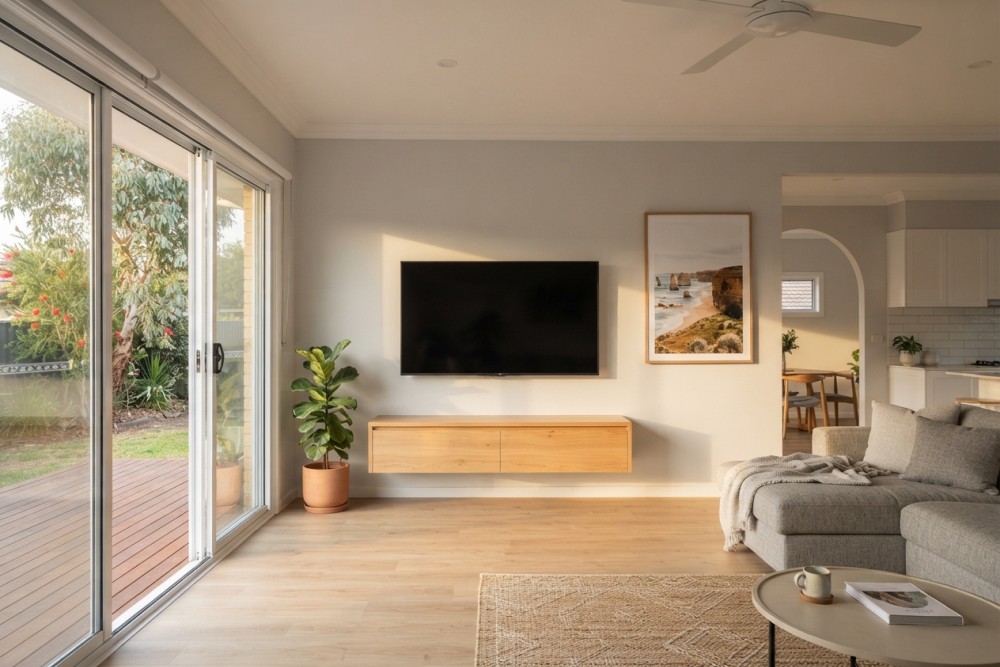
Boxes are still stacked against the wall in half the new builds going up around Tarneit, and the TV is usually still sitting on a stand nobody’s decided is permanent. Settlement day comes with a hundred more urgent things than a wall mount, so the screen sits there for weeks, sometimes months, propped against the skirting board.
That delay isn’t really about putting it off. Estates like Tarneit Central and The Grove are full of near-identical floor plans, and TV wall mounting in Tarneit runs into the same snag in almost every one of them: it’s not always obvious what’s actually behind the plasterboard until someone starts drilling into it.
Why Newer Homes Don’t Behave Like Older Ones
Project homes go up fast, and the internal walls show it. Instead of the double brick or solid render you’d find in an older Geelong home, most Tarneit builds use lightweight plasterboard over a steel or timber frame. It holds a picture frame without any trouble. A 65-inch TV is a different job altogether. Treat the wall that way from the start.
The studs aren’t always where you’d expect them either.
Older homes tend to run wall studs at a fairly predictable 450 or 600 millimetre spacing. Volume builders cut that consistency more often than most buyers realise, and spacing can shift around a window, a doorway, or wherever the frame needed extra bracing during construction. A stud finder helps, but it can just as easily pick up a cable or a pipe running behind the sheet and convince you it’s found timber when it hasn’t. None of that shows up until the drill’s already in the wall. Getting this wrong means the mount ends up holding on with little more than gap-filler and hope.
Finding a Stud in a Wall That’s Only a Few Months Old
Tapping the wall and listening for a change in sound still works better than most tools give it credit for. A hollow knock usually means plasterboard on its own, and a firmer thud means a stud or noggin sits behind it. Some builders hand over frame plans at settlement, and it’s worth digging that folder out, or calling the property manager, before anyone reaches for a drill.
The Cable Question Nobody Thinks About Until the TV’s Already Up
A mounted TV with three cables hanging down the wall looks worse than one still sitting on a unit. Most DIY jobs come unstuck here, because running cable through a cavity wall isn’t the same as running an extension lead along a skirting board.
Power is the part people get wrong.
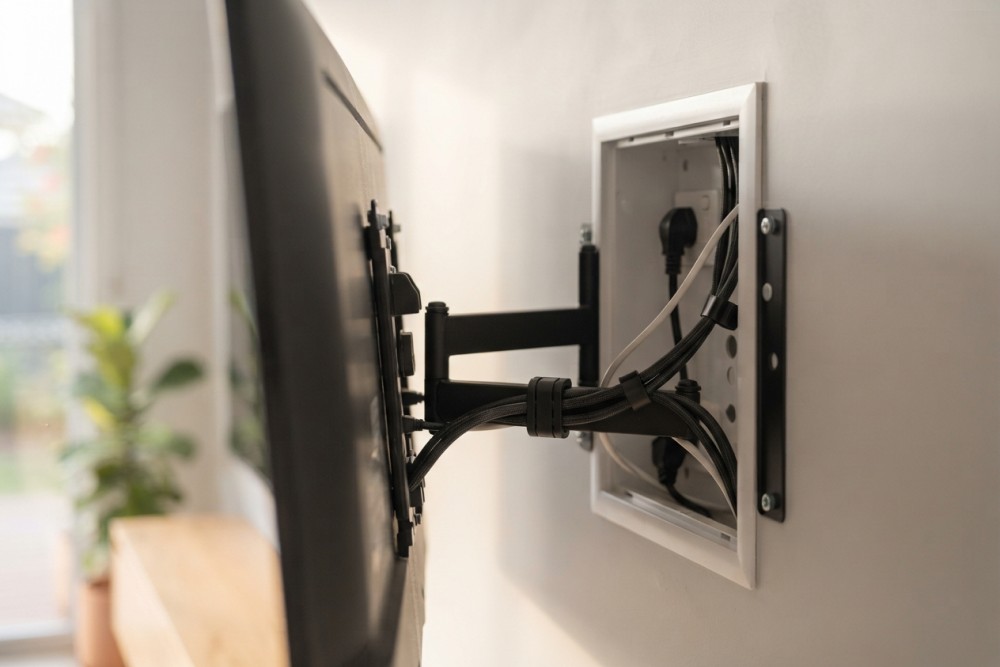
General power isn’t meant to run through a wall cavity without the right fittings, and skipping that step puts both the TV and the wall at risk. A licensed electrician can fit an in-wall power and cable kit that tucks the leads away completely and keeps the whole job to standard. It costs more than skipping it, but a lot less than fixing a wall afterwards.
A few options, depending on the budget and the wall:
- A surface-mounted cable cover, painted to match the wall, sitting over the leads rather than inside them
- A low-voltage in-wall kit for HDMI and audio leads, which doesn’t need an electrician
- A dedicated in-wall power kit, fitted by a licensed electrician, for the actual power lead
Picking a Mount for the Room You Actually Have
Not every wall calls for the same bracket. A fixed mount suits a media room where the couch sits dead in front of the screen and never moves, while a tilting mount earns its price above a fireplace, angling the screen down to counter the extra height. Full-motion arms suit open-plan spaces instead, letting the screen swing toward the kitchen for the one sports final a year that actually matters.
- Fixed mount: sits flush against the wall, no adjustment once it’s up
- Tilting mount: several degrees of downward tilt, worth it above a mantel or fireplace
- Full-motion mount: extends and swings from the wall, suited to rooms with more than one seating angle
Brick Feature Walls Change the Job Completely
A growing number of Tarneit living rooms have a feature wall running floor to ceiling, whether that’s exposed brick, stacked stone, or large-format tile around a fireplace. Masonry anchors replace the timber screws used on plasterboard, and the mount needs to sit level across a surface that’s rarely as flat as it looks from the couch. Getting this wrong on a feature wall costs more to fix than a mistake on plaster, because patching tile or stone isn’t a five-minute job with a tub of filler.
What Tends to Go Wrong When It’s a Weekend Job
- Mounting straight into plaster with no stud or a wall anchor rated for the TV’s actual weight
- Hanging the screen too high because the bracket went in before anyone sat on the couch to check the angle
- Cutting into a wall cavity without checking what’s already running behind it
- Leaving cables visible because the cable kit got ordered after the mount, not before
The height one catches people out more than any other. A TV mounted at standing eye level looks fine in an empty room and wrong the moment someone actually sits down.
None of this is a reason to leave the TV on the floor for another month. A couple of photos of the wall sent through beforehand is usually enough for the team to tell you what the job actually involves, cable kit included, before anyone shows up with a drill.